


Powered by goKaizen Capital
The process, from submission to funding. Seven stages, each with a clear owner and a clear output.

A principal reviews your complete submission within one business day: the numbers, the basis, the plan. You receive a direct call with our assessment and a view on structure, whichever way the answer goes.

Where there is a fit, we present a written engagement letter covering the scope of work, the capital strategy we recommend, and our compensation. Everything is agreed in writing before work begins; the initial review carries no charge.

A private portal opens for your transaction: the document ledger, the deal register, term sheets as they arrive, and a direct line to the desk. You have visibility into every step of the process from inside it.

We present the transaction to selected capital sources in parallel and in confidence. Each source is chosen for demonstrated appetite in your asset class, structure, and market; every conversation is logged to your file.

Offers are standardized into a single comparison covering proceeds, pricing, structure, covenants, and certainty of close. Our recommendation is delivered alongside it, with the reasoning in full.

We coordinate third-party reports, legal documentation, and lender requirements against a managed timeline, and work every date on the critical path through funding.

After your first closing you hold permanent client standing: your transaction records preserved, access to the member library, and a direct line to the desk for whatever you build next.
Every deal is paid for with layers of money. Getting the layers right, and the people behind them, is the work.
There is no standard way to pay for a property. The stack can be shaped conservatively, stretched with a single lender, or layered with capital between the loan and the sponsor; each shape carries a different cost, a different risk, and a different return to the people at the top. Our work is to find the shape the situation actually calls for, and then fill it.
Which shape is right falls out of the numbers. We model the blended cost of capital under each structure against the returns the plan produces: levered returns, cash-on-cash through the hold, coverage, and debt yield. A layer earns its place only when the capital it replaces costs more than it does, and the analysis travels with our recommendation so you can see the arithmetic, not just the answer.
When the desk takes a deal out, the market is approached in parallel and in confidence, so lenders compete without the deal being shopped. Quotes come back in different shapes and vocabularies; we translate every one into a single grammar and read all of it, not just the two lines everyone reads.
The right source of capital is a judgment, not a lookup. The desk makes that call from the whole term sheet and from what the paper cannot say: how the counterparty behaves. Six of the things the judgment weighs:
Coverage and debt-yield tests decide whether your loan behaves during the plan, not just at closing. A test you would fail in month eight is a default you signed up for in month one. We model the tests against your plan before you sign, not after.
Every quote is sized by whichever test bites first: value, cost, coverage, or debt yield. Two lenders quoting the same leverage rarely mean the same dollars. We find the constraint that actually binds and negotiate against that one.
Yield maintenance, lockouts, and minimum-interest clauses decide what your exit costs. A loan you cannot leave is a loan that prices your sale. The exit is underwritten on day one.
A bank lends deposits under a regulator. A debt fund lends discretionary capital, often on leverage of its own. A conduit lends to sell the loan. That difference decides who re-trades under stress, who closes on time, and who behaves when the market moves mid-deal.
Appetite moves weekly. The lender who won a deal in March may be pencils-down by June. The desk prices against the market as it stands this morning, from live conversations, not last quarter’s survey.
Draw administration, sweep triggers, extension approvals, workout posture. The desk has watched these counterparties operate across live files; that record is part of the underwriting, and it is why the cheapest quote is often the most expensive loan.


The read is already underway. These are the desk’s own working papers: the checklist your read runs against, templates for the numbers every lender asks about, and the firm’s file on itself. Yours to keep, no key required.
Want to move faster? Put your numbers on these papers and send them ahead to deals@credealteam.com. A file that arrives complete can go from first read to terms of engagement in the same week.
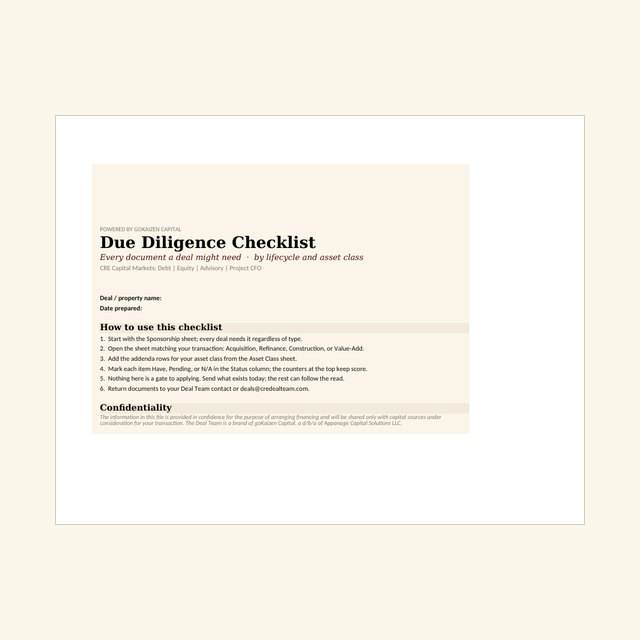
Every document a deal might need, organized by lifecycle and asset class, with a status column that keeps score.
Download ↓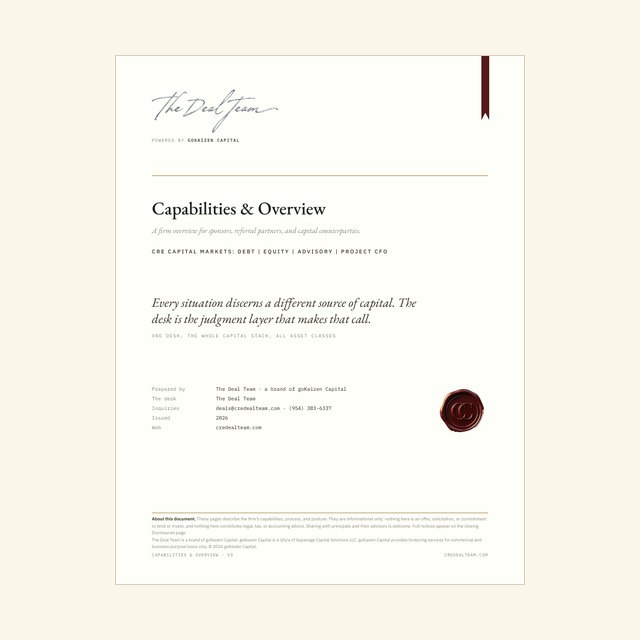
The firm, the desk, and what it arranges: debt, equity, and the structures in between.
Download ↓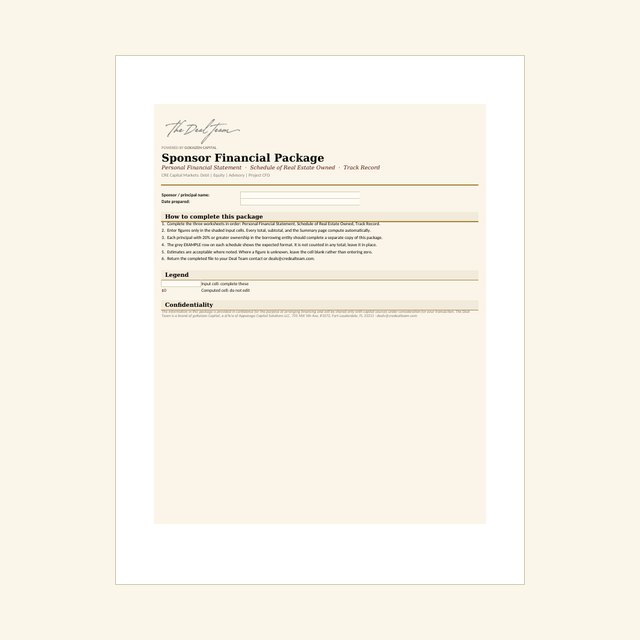
Personal financial statement, real estate schedule, and track record in one workbook, assembled once and reused on every deal.
Download ↓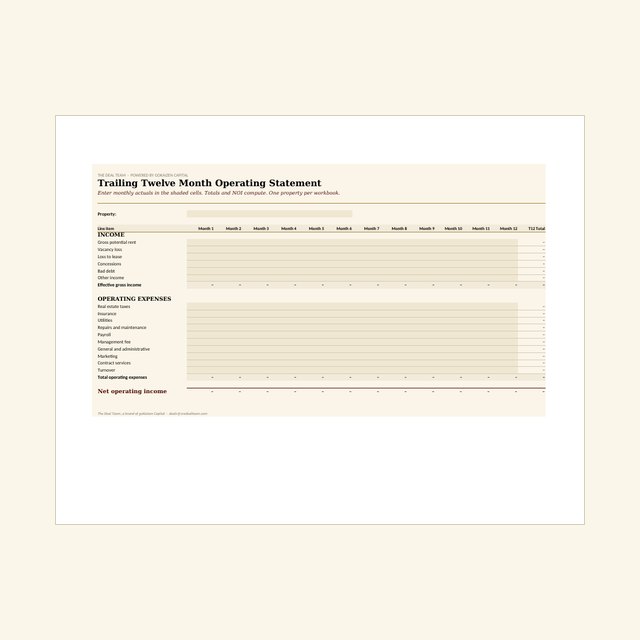
Twelve months of operations with income, expenses, and NOI computed, printing to a single clean page.
Download ↓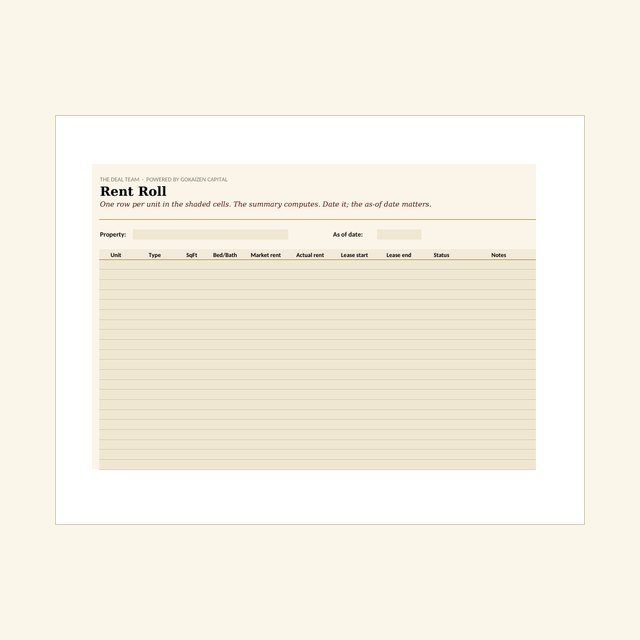
One row per unit; occupancy, total rent, and averages compute in the summary.
Download ↓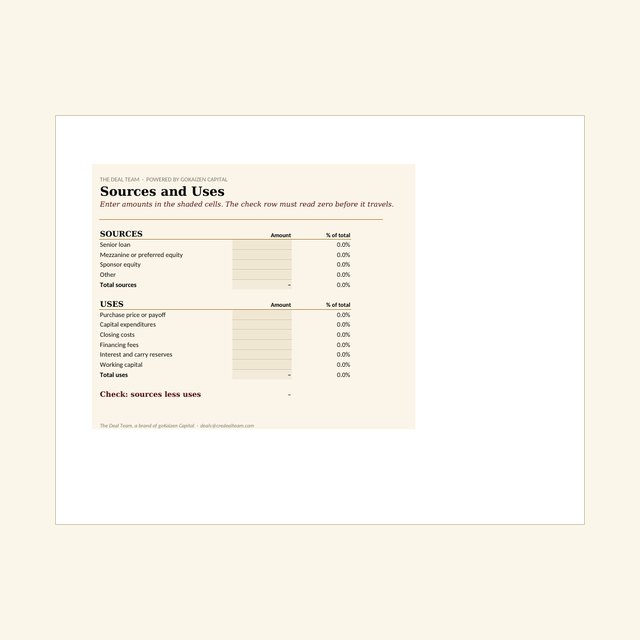
Where the money comes from and where it goes, with a check row that ties to zero before it travels.
Download ↓The ones every sponsor asks while the read is underway.
Forgot a document, or thought of something the desk should know before the read? Leave it here; it files straight to your application.
The desk reads its own mail. No routing tree, no ticket number.
One business day. A principal calls: a person, with a view, either way.
This room is open to every applicant. The rooms past it are earned, and they stay yours.
Your deal’s private room: the live register, the term-sheet inbox, the document ledger, the thread with the desk. Opens the day we take your deal on.
Permanent standing. The closed-deal vault: HUDs, wires, the record, plus the member library and the desk’s ear for whatever you’re building next.
The desk publishes the way it works: one idea at a time, in frames like these. The full set lives at @the.deal.team.